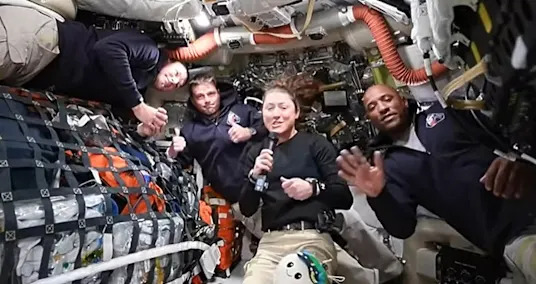
MOSCOW (Reuters) -A Russian Soyuz MS-28 spacecraft with two Russian cosmonauts and one NASA astronaut on board successfully docked with the International Space Station on Thursday, Russian space agency Roscosmos said.
But the agency later reported that the launch pad at the Baikonur Cosmodrome in Kazakhstan had sustained damage from the launch. It said the damage would be quickly repaired.
The Soyuz 2.1a rocket lifted off from the Baikonur Cosmodrome at 12:28 p.m. Moscow time (0928 GMT).
Late on Thursday, Russian news agencies quoted Roscosmos as saying the launch had taken place without incident, but damage was observed after an inspection of the launch area.
"Damage to a number of elements of the launch pad was detected. An assessment of the state of the launch complex is being conducted now," the agencies quoted Roscosmos as saying.
"All the necessary reserve elements are there to restore it and the damage will be eliminated very soon."
It said the crew was on board the station and in good health.
(Reporting by Anastasia Lyrchikova; Writing by Marina Bobrova; Editing by Andrew Osborn, Ron Popeski and Bill Berkrot)
LATEST POSTS
- 1
 The Golden Globes is happening Sunday: Who's nominated, who's hosting and how to watch
 - 2NASA's Artemis astronauts enter final preparations for Moon mission
- 3Monetary Versatility: Get ready for Life's Unforeseen Difficulties
- 4NASA Artemis 2 astronauts to make historic moon flyby today. Here's what to expect hour by hour (timeline)
- 5Bother Control Administrations for 2024: Decide for Your Home



- Kremlin: Russian troops conquer Pokrovsk after year of intense combat
- 6 U.S. States for Climbing
- New dinosaur tracks in Italy illustrate herds moving in unison
- Dominating Online Entertainment Showcasing: 7 Hints for Organizations
- Euclid space telescope sees gorgeous cosmic cloud | Space photo of the day for Nov. 18, 2025
- Dave Coulier shares new cancer diagnosis 1 year after revealing previous diagnosis
- The most effective method to Pick the Best Wellbeing Highlights for Seniors in SUVs
- 'Not the moon that I'm used to seeing': Artemis II astronauts describe seeing the far side
- The Most Paramount Crossroads in Olympic History