When you buy through links on our articles, Future and its syndication partners may earn a commission.

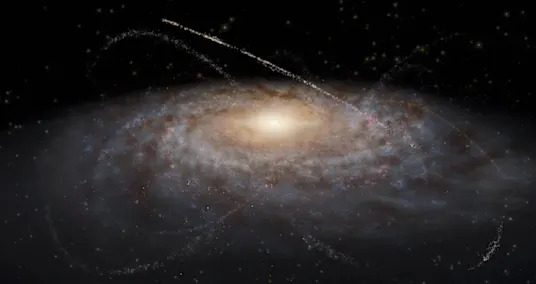
Astronomers have discovered dozens of faint ribbons of stars in the outskirts of the Milky Way using data from the European Space Agency's Gaia mission.
The findings were made using a new algorithm that more than quadruples the number of known candidates of these so-called "stellar streams." This discovery could offer fresh clues about how our galaxy evolved and how its dark matter is distributed, the study's researchers say.
Stellar streams are arcing threads of stars that form when compact star clusters travel through the Milky Way's gravitational field, shedding stars that are stretched out into long, trailing ribbons.
"It's like riding a bike with a bag of sand, only the bag has a hole in it," study co-author Oleg Gnedin, a theoretical astrophysicist at the University of Michigan, said in a statement. "Those grains of sand are like the stars left behind along their trajectory."
Finding stellar streams is valuable because the shapes and motions of these phenomena preserve a record of what gravitational forces have acted on them over time. That makes them powerful tools for mapping the Milky Way's mass, and that mass measurement would include its elusive dark matter halo — dark matter being the invisible "glue" thought to hold galaxies together, but has yet to be observed directly despite decades of effort.
The new study, led by Yingtian "Bill" Chen of the University of Michigan, identifies 87 stellar stream candidates associated with globular clusters, which are dense, ancient groupings of stars that orbit the Milky Way. Previously, fewer than 20 stellar streams had been identified, often only serendipitously in Gaia data, leaving astronomers with too small a sample size to draw broad conclusions.
Most known stellar streams come from dwarf galaxies or clusters that have already been largely torn apart. Streams from still-surviving globular clusters, like those identified in the new study, are much rarer and especially useful because astronomers can compare the stream directly with its parent cluster.
To find them, Chen developed a computer algorithm called StarStream, which searches for streams using a physics-based model rather than relying on visual patterns alone, according to the study. The team then applied the method to Gaia data, which from 2014 to 2025 mapped the positions and motions of billions of stars in the Milky Way.
"It turns out that it's a lot easier to find things when you have a theoretical expectation of what you're looking for when you have a simple phenomenological picture," Gnedin said in the statement.
The results also revealed that many streams do not match the classic expectation of thin, well-aligned trails. Instead, the study reports that some of the newfound streams are shorter, wider or even misaligned with their parent clusters' orbits — suggesting earlier searches may have missed them by focusing only on the most obvious structures.
The expanded sample also provides evidence that some diffuse globular clusters are shedding stars at unusually high rates, a sign they may be nearing complete tidal disruption, the study reports.
Not all 87 candidates are expected to be confirmed, however, as some detections have lower confidence due to background contamination from unrelated stars, the researchers say.
The study's results, along with the algorithm applied to them, can be tested with upcoming observations from next-generation facilities — including the Vera C. Rubin Observatory, NASA's Nancy Grace Roman Space Telescope and the Dark Energy Spectroscopic Instrument — to help verify which streams are real, Chen said in the statement.
"It'll be very easy to adjust the algorithm to future missions," he said. "Once we have the data, it will be very straightforward to apply it."
This research is described in a paper published March 23 in The Astrophysical Journal.
LATEST POSTS
- 1
 Remain Fit and Sound with These Exercise Fundamentals
 - 2Doritos and Cheetos debut 'NKD' options, without artificial colors or flavors
- 3Where should we send a real 'Hail Mary' spacecraft? A new study has the answers
- 4Infants will no longer receive hepatitis B vaccine at birth, CDC announces
- 5The most effective method to Amplify Your Opportunity for growth in a Web-based Degree Program




- Top 15 Web-based Entertainment Stages for Individual Marking
- 5 Food varieties to Remember for Your Eating regimen for Ideal Wellbeing
- Manual for extravagance SUVs for seniors
- The most effective method to Alter Your Savvy Bed for A definitive Rest Insight
- NASA astronauts take new moonsuit for a swim | Space photo of the day for Nov. 28, 2025
- The most effective method to Pick the Right Material Organization: Fundamental Tips
- Explainer-Why are hepatitis B vaccines given to newborns?
- In Antarctica, photos show a remote area teeming with life amid growing risks from climate change
- Significant Elements to Consider Prior to Applying for a Mastercard: 6 Vital Contemplations